
Galvanizing Plant Setup Cost in India: Complete Breakdown
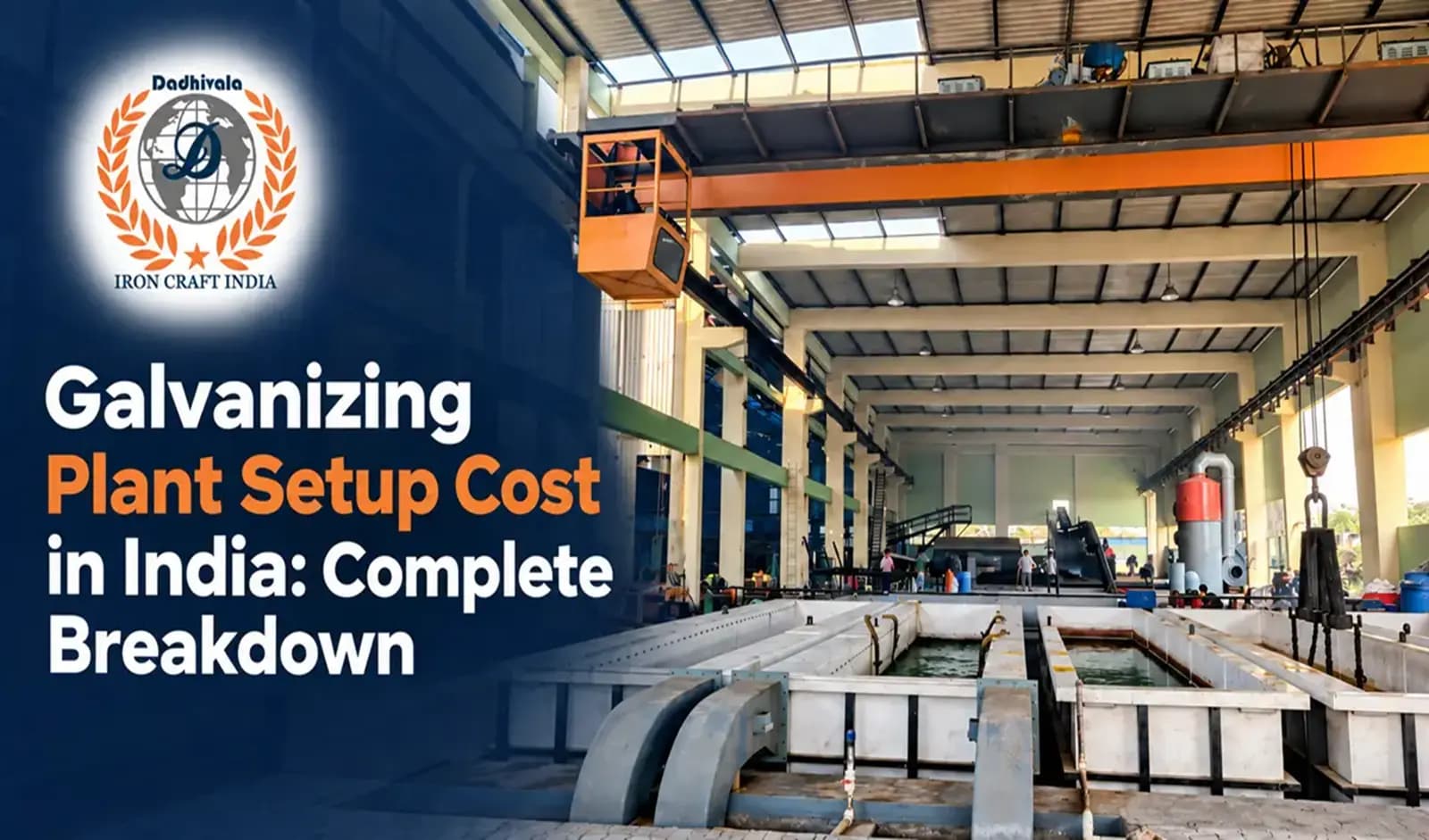
Setting up a hot-dip galvanizing plant in India costs from around ₹2 crore for a micro unit to ₹70 crore or more for a large automated plant. For most MSMEs targeting 5-10 TPD, a realistic all-in investment including land is ₹8-14 crore - and within that, the initial zinc bath charge alone accounts for ₹1.9-3.5 crore.
That last figure is what most first-time project reports leave out, and it is the main reason galvanizing projects run short of funds midway. This breakdown covers every head you will actually spend on, with a payback model built on current zinc prices rather than optimistic assumptions.
Important: All costs here are indicative market ranges as of September 2026. Actual cost depends on your state, plot, kettle size and automation level. Use these as a budgeting starting point, not a quotation.
1. Fixed Capital (One-Time Investment)
Fixed capital splits into five uneven parts: land, civil work, machinery, the zinc bath and utilities. Only machinery scales predictably with capacity - land can swing by a factor of five depending on the estate you choose, and the zinc bath is driven by kettle dimensions rather than by daily tonnage. Each of these heads attaches to a specific stage of the build, so it helps to read this budget alongside the full process of setting up a hot-dip galvanizing plant in India, from site selection through to commissioning.
1.1 Land & Site Development
A galvanizing plant needs more space than the kettle footprint suggests: bay length for long structurals, a pre-treatment tank line, quench and passivation zone, an ETP corner and open yards. A 1-2 TPD unit manages in 4,000-8,000 sq.ft, a 3-5 TPD plant needs 8,000-15,000 sq.ft, a 5-10 TPD plant 15,000-30,000 sq.ft, and anything above 15 TPD starts at 40,000 sq.ft.
Land cost is the most unpredictable figure in the project. Industrial plot rates currently run ₹1,200 to ₹7,000 per sq.ft, and both ends are real. Interior GIDC and MIDC estates still sell in the ₹1,200-2,000 band, while developed tier-2 estates with highway connectivity have moved to ₹5,000-7,000.
| Expense Head | Cost Range (INR) | Notes |
|---|---|---|
| Industrial land | ₹1,200 - ₹7,000/sq.ft | Interior estates low; developed tier-2 estates ₹5,000+ |
| Registration & stamp duty | 5% - 7% of land value | Some states reimburse for new units |
| Boundary wall & gate | ₹4 - ₹10 Lakh | 6-8 ft with fencing |
| Roads, drainage & effluent channels | ₹6 - ₹15 Lakh | Acid-resistant, sloped towards ETP |
| Levelling & soil testing | ₹1 - ₹4 Lakh | Needed for kettle foundation design |
Land and site development together come to ₹1 crore to ₹8 crore. Because that spread is so wide, many first-time galvanizers start in a rented shed at ₹15-35 per sq.ft per month, which cuts entry cost by 30-50%. The trade-off is no collateral for the bank and landlord permission needed for kettle foundations and pollution-control consent.
1.2 Civil Works & Building
Civil work here is not ordinary shed construction. Three things push it above a standard warehouse: eave height for crane clearance, the heat-resistant furnace foundation, and acid-resistant flooring across the pre-treatment area.
| Expense Head | Cost Range (INR) | Notes |
|---|---|---|
| Factory shed (PEB structure) | ₹1,000 - ₹2,500/sq.ft | Higher eaves and wider spans push past ₹2,000 |
| Crane gantry beams & columns | ₹8 - ₹25 Lakh | Sized for crane capacity |
| Furnace foundation & refractory pit | ₹10 - ₹30 Lakh | Often quoted with the furnace |
| Acid-resistant flooring & tank pits | ₹200 - ₹450/sq.ft | Over 30-50% of covered area |
| Office, lab, ventilation & fire safety | ₹14 - ₹35 Lakh | Cabin, stack, ducting, hydrants, NOC compliance |
Total: ₹1 crore - ₹3.5 crore. Get the furnace vendor to specify the foundation before you finalise the civil contractor - a generic foundation modified later costs considerably more.
1.3 Plant & Machinery
Quotations vary widely between vendors mainly because they include different things. A quote that looks 20% cheaper often excludes erection, the acid fume scrubber or the ETP - and those three together can be a third of the bill.
The kettle and furnace dominate. Kettle cost scales sharply with length and steel grade: short kettles sit in the ₹12-20 lakh band, while boiler-quality plate kettles for 7 m+ lines run ₹45 lakh and above. The furnace is frequently the larger of the two.
| Expense Head | Cost Range (INR) |
|---|---|
| Zinc kettle (3 m to 12 m+) | ₹12 - ₹60 Lakh |
| Furnace / burner system | ₹25 - ₹90 Lakh |
| Overhead crane (3-10 Ton) | ₹8 - ₹25 Lakh |
| Pre-treatment tank line (degreasing, pickling, rinsing, flux) | ₹12 - ₹34 Lakh |
| Drying oven / pre-heating chamber | ₹5 - ₹12 Lakh |
| Quenching & passivation system | ₹5 - ₹12 Lakh |
| Fume extraction hood & ducting | ₹6 - ₹15 Lakh |
| Wet scrubber + acid fume scrubber | ₹15 - ₹37 Lakh |
| Effluent Treatment Plant (ETP) | ₹8 - ₹40 Lakh |
| Jigs, handling & testing equipment | ₹4 - ₹12 Lakh |
| Erection & commissioning | 8% - 15% of machinery cost |
| Trial runs & calibration | ₹2 - ₹6 Lakh |
Total: ₹1.2 crore - ₹4 crore. Before finalising a supplier, visit at least three of their running installations and ask the operators, not the sales team, about kettle life and dross generation.
1.4 Initial Zinc Bath Charge
This head is frequently larger than the entire machinery bill, and it is the one most first-time reports omit. Before a single kilogram can be galvanized, the kettle must be filled with molten zinc and kept full permanently. Molten zinc weighs about 6.5 tonnes per cubic metre, so kettle volume converts directly into a very large one-time purchase.
Crucially, this cost is driven by the length of jobs you intend to handle, not by daily tonnage. A fabricator galvanizing 9-metre poles needs a long kettle and an enormous zinc charge even at modest throughput.
| Kettle Size (approx.) | Zinc Required | Cost at ₹270-₹320/kg |
|---|---|---|
| 3.0 m × 0.9 m × 1.2 m | 15 - 22 Tonnes | ₹40 - ₹70 Lakh |
| 5.0 m × 1.0 m × 1.5 m | 35 - 50 Tonnes | ₹95 Lakh - ₹1.6 Cr |
| 7.0 m × 1.2 m × 1.8 m | 70 - 110 Tonnes | ₹1.9 - ₹3.5 Cr |
| 10 m+ × 1.5 m × 2.2 m | 150 - 250 Tonnes | ₹4 - ₹8 Cr |
SHG 99.995% zinc has traded in the ₹250-₹360 per kg band through 2026, tracking LME and MCX. On a 90-tonne bath, a ₹30/kg swing changes project cost by ₹27 lakh, so budget against a live quote, not a year-old reference.
The good news: zinc in the kettle is an asset, not an expense, and most banks will fund it as a separate term loan component or inventory limit. But it must appear in the DPR explicitly, or your sanction will fall short exactly at commissioning.
1.5 Utilities & Infrastructure
Galvanizing is power-hungry, fuel-hungry and water-hungry at once. Where piped natural gas is available in the estate it is almost always the cheapest long-run fuel and worth the higher connection cost, since the running-cost difference compounds every month.
| Expense Head | Cost Range (INR) |
|---|---|
| HT power connection (100-250 KVA) | ₹6 - ₹15 Lakh |
| Transformer, panel & DG backup | ₹10 - ₹24 Lakh |
| PNG / LPG connection & gas bank | ₹5 - ₹20 Lakh |
| Water connection, borewell & storage | ₹3 - ₹10 Lakh |
| Compressed air system | ₹3 - ₹8 Lakh |
| Internal piping (acid, water, air, gas) | ₹6 - ₹15 Lakh |
| Wiring & control panels | ₹8 - ₹18 Lakh |
Total: ₹40 lakh - ₹1 crore. Apply for the HT connection the day your land is registered. In most states this single step determines your commissioning date.
1.6 Pre-Operative & Approvals
The statutory fees are modest; the consultancy and follow-up around them is what costs time and money. Galvanizing is a red-category activity in most states, so Consent to Establish is a substantive technical review. Your scrubber and ETP design will be scrutinised, and conditions imposed here can add unbudgeted capital cost.
| Expense Head | Cost Range (INR) |
|---|---|
| DPR preparation (consultant) | ₹60,000 - ₹2.5 Lakh |
| Consent to Establish + Consent to Operate | ₹50,000 - ₹3 Lakh |
| Hazardous waste authorisation | ₹15,000 - ₹60,000 |
| Environmental clearance (if applicable) | ₹2 - ₹8 Lakh |
| Factory licence & fire NOC | ₹60,000 - ₹2.3 Lakh |
| CEIG electrical approval | ₹25,000 - ₹80,000 |
| Udyam (MSME) registration | Nil |
| GST, incorporation, legal & CA fees | ₹50,000 - ₹1.5 Lakh |
Total: ₹6 lakh - ₹20 lakh. Start the CTE application in parallel with civil work. Sequencing these one after the other is what turns a twelve-month project into an eighteen-month one.
1.7 Contingency
Budget a contingency of 7% to 12% of capital cost, roughly ₹30 lakh on a small project and over ₹1 crore on a medium one. Galvanizing projects overrun for three predictable reasons: zinc prices move between sanction and purchase, pollution-control authorities impose conditions requiring extra scrubber or ETP capacity, and HT power release slips while fixed costs keep accruing. None of these are exceptional. They are the normal pattern, which is why 5% rarely holds.
2. Working Capital (Monthly Recurring)
Once commissioned, the cost structure changes character completely. Monthly operations are dominated by one input, zinc, which alone accounts for over half of operating cost. Your profitability is tied to the LME as tightly as it is to your order book.
The figures below model a 5 TPD plant at 70% utilisation, roughly 90-95 tonnes of steel per month across 26 working days.
2.1 Raw Materials & Consumables
Zinc consumption runs at 4% to 8% of the weight of steel dipped, with 5-7% typical for a mixed job profile. Heavy structurals sit at the lower end; thin sections, pipes and small hardware can touch 10%. A single percentage point of pickup is worth about ₹3 per kilogram of throughput, which makes this the most important operating number in the plant.
| Expense Head | Cost Range (INR / month) |
|---|---|
| Zinc replenishment (4.5-6.5 T @ ₹270-₹320/kg) | ₹13 - ₹20 Lakh |
| Hydrochloric acid (30-33%) | ₹1 - ₹2.5 Lakh |
| Flux (zinc ammonium chloride) | ₹60,000 - ₹1.5 Lakh |
| Passivation & degreasing chemicals | ₹80,000 - ₹2 Lakh |
| ETP chemicals | ₹30,000 - ₹80,000 |
Total: ₹16 - ₹27 lakh per month. Against this, zinc ash and dross are saleable by-products and a well-run plant recovers 8-15% of its zinc spend by selling them. Show this in the DPR as revenue. On a 5 TPD unit it is the difference between a marginal month and a profitable one.
2.2 Labour & Staff
A 5 TPD plant runs with one production manager, three to five skilled operators covering kettle, crane, pre-treatment and ETP, and five to ten helpers.
| Role | Monthly Cost (INR) |
|---|---|
| Plant / production manager (1) | ₹50,000 - ₹1,00,000 |
| Skilled operators (3-5) | ₹18,000 - ₹30,000 each |
| Helpers / jigging staff (5-10) | ₹12,000 - ₹18,000 each |
| Quality technician & admin (2) | ₹18,000 - ₹35,000 each |
| Security (2) | ₹13,000 - ₹20,000 each |
| PF, ESIC, bonus & statutory | 12% - 18% of wage bill |
Total: ₹3.5 - ₹6.5 lakh per month. The scarce resource is an experienced kettle operator. Bath temperature control, dross management and jigging technique are learned on the floor, and the difference between a good operator and an average one shows up directly in your zinc consumption.
2.3 Utilities & Overheads
The defining feature of galvanizing economics is that the kettle stays hot around the clock. You cannot let a bath solidify and reheat it daily without shortening kettle life. Fuel is consumed whether or not there is work in the plant, which makes utilisation the most powerful lever over unit cost.
| Expense Head | Cost Range (INR / month) |
|---|---|
| Fuel for kettle heating (PNG/LPG/diesel) | ₹2.5 - ₹5 Lakh |
| Electricity (10,000-18,000 units) | ₹1.5 - ₹3.5 Lakh |
| Water & effluent disposal | ₹40,000 - ₹1 Lakh |
| Maintenance, spares & refractory | ₹60,000 - ₹1.5 Lakh |
| Insurance (fire, machinery, stock) | ₹25,000 - ₹60,000 |
| Freight, marketing & commission | ₹90,000 - ₹2.5 Lakh |
Effective HT industrial power costs roughly ₹7.5-₹8.5 per unit in Gujarat after fuel adjustment, demand charges and duty, and ₹7-₹10 across most states. Utilities and overheads add ₹6.5 - ₹14 lakh per month, taking total monthly working capital for a 5 TPD plant to ₹26 - ₹48 lakh.
2.4 Loan Servicing & Debt Coverage
A ₹3 crore term loan at around 10% over seven years carries an EMI of roughly ₹4.8-₹5.5 lakh per month; a ₹6 crore loan runs ₹9.5-₹11 lakh. A working capital limit adds ₹40,000 to ₹1.5 lakh in monthly interest.
This is where many galvanizing project reports quietly fall apart. Banks fund against debt service coverage ratio, and most expect an average DSCR of at least 1.5 with no year below 1.25. On a ₹5 crore project with 30% promoter contribution, the term loan is about ₹3.5 crore and the EMI roughly ₹5.7 lakh, which against the base-case profit in section 4 produces a DSCR of only 1.1-1.3. Workable, but tight enough that appraisal will hinge on your projected utilisation. Raising promoter contribution to 35-40%, or funding the zinc bath through a separate inventory limit, improves the ratio materially.
3. Total Project Cost Summary (Capacity-Wise)
Land is shown separately because it varies more than every other head combined.
| Plant Type | Capacity | Plant + Civil Capex | Initial Zinc Bath | Total Capex Excl. Land |
|---|---|---|---|---|
| Micro | 1-2 TPD | ₹1.2 - ₹2.5 Cr | ₹40 - ₹70 Lakh | ₹1.6 - ₹3.2 Cr |
| Small | 3-5 TPD | ₹2.2 - ₹4 Cr | ₹95 Lakh - ₹1.6 Cr | ₹3.1 - ₹5.6 Cr |
| Medium | 5-10 TPD | ₹3.5 - ₹6.5 Cr | ₹1.9 - ₹3.5 Cr | ₹5.4 - ₹10 Cr |
| Large | 15-30 TPD | ₹7 - ₹16 Cr | ₹4 - ₹8 Cr | ₹11 - ₹24 Cr |
| Very Large | 50-100+ TPD | ₹20 - ₹45 Cr | ₹8 - ₹20 Cr | ₹28 - ₹65 Cr |
| Plant Type | Land (if purchased) | Working Capital (1 month) | Timeline |
|---|---|---|---|
| Micro | ₹50 Lakh - ₹3 Cr | ₹10 - ₹18 Lakh | 6 - 9 months |
| Small | ₹1 - ₹5 Cr | ₹18 - ₹32 Lakh | 9 - 12 months |
| Medium | ₹2 - ₹8 Cr | ₹26 - ₹55 Lakh | 12 - 16 months |
| Large | ₹4 - ₹15 Cr | ₹80 Lakh - ₹1.8 Cr | 16 - 24 months |
| Very Large | ₹10 - ₹30 Cr | ₹2 - ₹5 Cr | 24 - 36 months |
A 5-10 TPD plant on owned land comes to ₹8-₹14 crore all-in, while the same plant in a rented shed starts nearer ₹6 crore. For a bank proposal, the number that matters is total capex plus one month of working capital plus contingency, and stress-test it at a zinc price 15% above today's, because that is the variance the industry has seen within a single year.
4. ROI & Payback Period
Galvanizing is a conversion business with a thin per-kilogram margin. Revenue figures are almost meaningless in isolation, because a large share of revenue is simply zinc passing through. The number that decides whether a plant survives is contribution per kilogram.
Contribution per kg = Galvanizing rate per kg
− (Zinc pickup % × Zinc price per kg)
− Conversion cost per kg
Four inputs drive this. Job-work rates currently run ₹25-₹45 per kg, with bulk structural work at the lower end and small or complex items commanding more. Zinc pickup sits between 4% and 8%. Zinc has ranged ₹250-₹360 per kg through 2026. Conversion cost (fuel, power, chemicals, labour and overheads together) runs ₹8-₹14 per kg, falling steeply as utilisation rises.
At a ₹32 rate with 5.5% pickup on ₹290 zinc, the zinc alone consumes ₹15.95 of that ₹32, which is half your revenue, before a single unit of electricity is paid for.
Worked Example - 5 TPD Unit
At 70% utilisation over 26 days (≈91 tonnes/month), ₹32/kg rate, 5.5% pickup, zinc at ₹290/kg:
| Line | Per kg | Per month (91 T) |
|---|---|---|
| Revenue (job work) | ₹32.00 | ₹29.1 Lakh |
| Less: zinc consumed | ₹15.95 | ₹14.5 Lakh |
| Less: fuel, power, chemicals, ETP | ₹5.50 | ₹5.0 Lakh |
| Less: labour & overheads | ₹5.00 | ₹4.6 Lakh |
| Operating profit (EBITDA) | ₹5.55 | ₹5.0 Lakh |
| Add: zinc ash & dross recovery | ₹1.00 - ₹2.00 | ₹1.0 - ₹1.8 Lakh |
| Adjusted EBITDA | ₹6.5 - ₹7.5 | ₹6.0 - ₹6.8 Lakh |
The operating margin is roughly 20% of revenue before depreciation and interest. A plant that misses its utilisation target by fifteen points does not simply earn less. It moves close to break-even.
Payback Sensitivity
| Scenario | Utilisation | Rate | Monthly EBITDA | Payback on ~₹5 Cr Project |
|---|---|---|---|---|
| Conservative | 50% | ₹28/kg | ₹2 - ₹3 Lakh | 10+ years |
| Base case | 70% | ₹32/kg | ₹6 - ₹7 Lakh | 6 - 7 years |
| Strong | 85% | ₹38/kg | ₹12 - ₹15 Lakh | 3 - 4 years |
Payback claims of eighteen to twenty-four months do not survive contact with current zinc prices. A realistic expectation is four to seven years for a 5 TPD unit and three to five years for a 10 TPD or larger plant, because conversion cost per kilogram falls with scale while the zinc component stays fixed. Anyone presenting a two-year payback is either assuming zinc prices that no longer exist or omitting the bath charge from the investment figure.
Three levers actually move this outcome. Utilisation dominates everything. Fuel and labour are largely fixed, so each additional tonne through the same kettle is almost pure contribution, which is why tying up anchor customers before commissioning matters more than any equipment decision. Zinc efficiency comes next: better dross control, bath temperature and jigging can cut pickup by one to two points, worth ₹3-₹6 per kg. And job mix matters, because small, thin and awkward items pay more per kilogram than plain structurals and protect margin when structural volumes soften.
5. Recurring Costs Most Reports Miss
Beyond monthly operating heads, a galvanizing plant carries periodic costs that rarely appear in first-time project reports but arrive with complete certainty.
The largest is kettle replacement. A kettle lasts roughly five to ten years depending on temperature control and heating uniformity, and replacement means not just a new vessel but draining and re-handling the zinc bath, several weeks of furnace downtime and lost production. A sinking fund from year one is far easier than finding several tens of lakhs at short notice in year seven.
Alongside it sit zinc bath maintenance (periodic dross removal and ash skimming, which is recoverable, though the labour and production time are real costs), compliance renewals (Consent to Operate, TSDF sludge disposal billed by weight, periodic emission and effluent testing), and refractory relining and burner overhaul, which typically fall due every three to five years.
6. Government Schemes & Subsidies
Incentives reduce effective project cost meaningfully, but almost all are reimbursements after commissioning rather than upfront funding - your project must be fully financed without them.
On the credit side, CGTMSE now covers credit facilities up to ₹10 crore for micro and small enterprises, with guarantee coverage typically 75-85%. Guarantee-backed is not the same as security-free: banks still take primary charge over plant and machinery, and a guarantee fee applies. PMEGP offers margin money subsidy but its project ceilings sit well below a full galvanizing plant, so it is realistically useful only for a micro unit.
State incentives are usually the larger benefit. Most industrial states offer a capital investment subsidy on eligible fixed capital, with the percentage set by taluka or district category - in Gujarat this has typically ranged 10-25% by location, with comparable schemes in Maharashtra, Rajasthan, Madhya Pradesh, Tamil Nadu and Uttar Pradesh. Alongside this, state policies commonly provide an interest subsidy of 5-7% on term loans for about five years, with small additional percentages for young entrepreneurs, women entrepreneurs and registered startups.
Two categories are worth checking specifically here: several boards reimburse part of the cost of pollution-control and effluent treatment equipment (relevant, since scrubber and ETP together total ₹20-₹65 lakh), and depending on state policy you may get stamp duty reimbursement, electricity duty exemption and employment-linked incentives. Confirm current terms on the official portal before building any of these into a DPR.
Frequently Asked Questions
1. What is the minimum investment to start a hot-dip galvanizing plant in India?
A 1-2 TPD unit in a rented shed can start from roughly ₹1.7-₹3.4 crore including the zinc bath and one month of working capital. With owned land in a developed estate, the same unit comfortably crosses ₹4 crore.
2. Why is the zinc bath such a large part of the cost?
Because the kettle must stay full of molten zinc regardless of how much work passes through it. A 7-metre kettle holds 70-110 tonnes, which at 2026 prices means ₹1.9-₹3.5 crore permanently held in the bath. It is an asset rather than an expense, but it must be funded on day one.
3. How long does it take to set up a galvanizing plant?
Six to nine months for a micro unit and twelve to sixteen months for a 5-10 TPD plant, from land finalisation to commercial production. Consent to Establish and HT power release most often extend the timeline, so both should run in parallel with civil work.
4. How much land do I need for a 5 TPD plant?
About 8,000-15,000 sq.ft of plot with 6,000-10,000 sq.ft covered. Bay length matters more than raw area. A 6-metre kettle needs clearance at both ends to handle long members.
5. Is a galvanizing plant profitable in India?
It can be, but margin per kilogram is thin and highly sensitive to zinc price and utilisation. Plants running above 70% utilisation with controlled zinc pickup and a mixed order book perform well. Plants that commission without confirmed orders struggle, because the kettle burns fuel whether or not there is work in it.
6. What DSCR will a bank expect?
Most lenders look for an average debt service coverage ratio of at least 1.5, with no year below about 1.25. On a 5 TPD plant financed at 70% debt the base case works out closer to 1.1-1.3, which is why higher promoter contribution or separate zinc bath funding materially improves bankability.