
How to Calculate Hot-Dip Galvanizing Plant Capacity and TPD
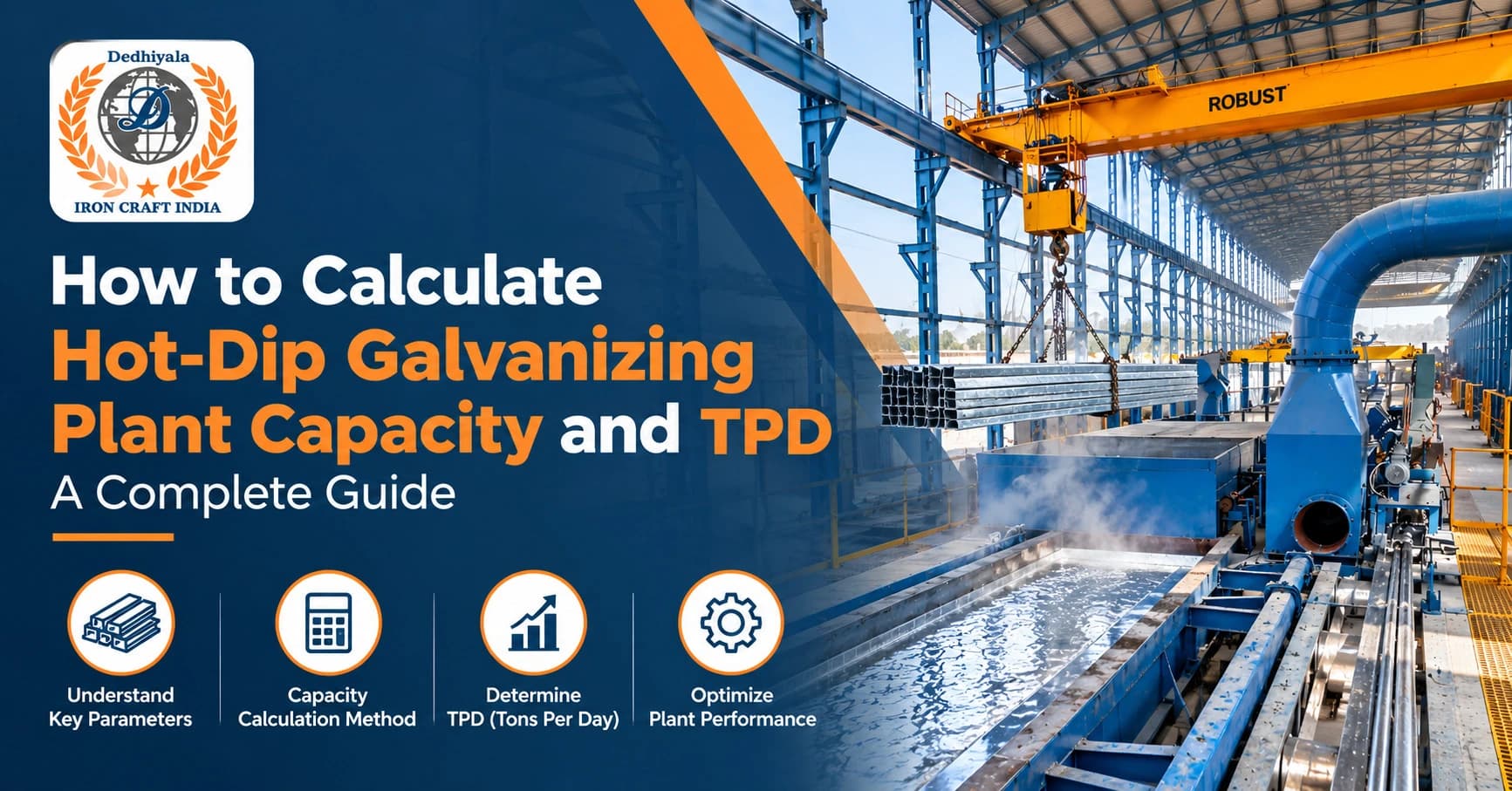
How to Calculate Hot-Dip Galvanizing Plant Capacity and TPD
Hot dip galvanizing plant capacity is the tonnage of steel your zinc kettle can coat in a given time. Calculate it as: hourly capacity (t/h) = load per dip (t) × dips per hour. Then multiply by operating hours and a utilisation factor to get capacity in tons per day (TPD). The kettle is usually the limit, but pickling, cranes or drying can become the bottleneck.
Every galvanizing project starts with one number: how many tonnes per day must this plant produce? Get it wrong and you either overspend on a kettle that sits idle or build a plant that cannot meet orders.
At Dadhivala Galvanizing, we have designed and built galvanizing plants since 1987 for pipe, structure, pole and crash-barrier manufacturers across India. This guide explains the method our engineers use to calculate galvanizing plant capacity, with formulas and worked examples you can apply to your own project.
Why Calculating Plant Capacity Matters
- Investment sizing: Kettle, furnace, cranes and tanks are all sized from the target TPD.
- Zinc and fuel budgeting: Both scale directly with tonnage.
- Order commitments: Customers expect reliable delivery dates.
- Financing and approvals: Banks and pollution control boards ask for rated capacity.
Understanding Hot-Dip Galvanizing
What Is Hot-Dip Galvanizing?
Hot-dip galvanizing is the process of immersing cleaned steel in molten zinc to form a metallurgically bonded zinc-iron coating. According to the American Galvanizers Association, the bath is held at 820–860°F (438–460°C) and contains at least 98% zinc. Most items stay in the bath for less than ten minutes, depending on steel thickness.
A batch plant follows a fixed sequence:
- Degreasing: Removes oil and dirt.
- Pickling: Dilute acid removes mill scale and rust.
- Rinsing: Prevents acid carry-over.
- Fluxing: A zinc ammonium chloride flux prevents oxidation before dipping.
- Drying: Pre-heats the steel and removes moisture.
- Galvanizing: Immersion in the zinc kettle.
- Quenching and passivation: Cools the steel and protects the fresh coating.
- Inspection: Checks coating thickness and finish.
Batch vs Continuous Galvanizing
This guide covers batch (general) galvanizing, where fabricated items such as pipes, structures, poles and barriers are dipped in a kettle. Continuous galvanizing lines coat steel coil and wire at line speed and are rated differently, by metres per minute. Batch plant capacity depends on load per dip and cycle time, which is why the calculation below starts there.
Benefits of Hot-Dip Galvanizing
- Long service life: A typical batch coating of 45–85 µm gives decades of protection in many environments.
- Complete coverage: Immersion coats inside, outside, edges and corners.
- Sacrificial protection: Zinc corrodes first, protecting exposed steel at scratches.
- Low lifetime cost: Little or no maintenance compared with paint systems.
Hot Dip Galvanizing Plant Capacity Calculation
Factors That Influence Galvanizing Plant Capacity
| Factor | Effect on capacity |
|---|---|
| Kettle size | Sets the maximum item size and load per dip |
| Load per dip | Heavier, well-packed jigs raise tonnage |
| Cycle time per dip | Faster cycles mean more dips per hour |
| Steel thickness and type | Thick sections need longer immersion |
| Heat input | Burners must reheat the bath after every dip |
| Pre-treatment speed | Slow pickling or fluxing starves the kettle |
| Crane capacity and speed | Limits load weight and transfer time |
| Operating hours and shifts | Defines available production time |
| Utilisation (OEE) | Accounts for breakdowns, changeovers and rework |
Step-by-Step Calculation Methodology
- Define the product mix. List item types, lengths, weights and wall thicknesses.
- Estimate the load per dip. Load per dip (t) = number of items per jig × weight per item.
- Measure the cycle time per dip. Add lowering, immersion, withdrawal, skimming and crane transfer time. Dips per hour = 60 ÷ cycle time (minutes).
- Calculate hourly capacity. Capacity (t/h) = load per dip × dips per hour.
- Check every other station. Pickling, fluxing, drying and quenching must match or exceed the kettle's hourly rate.
Worked Example: Structure Galvanizing Plant
| Input | Value |
|---|---|
| Kettle (L × W × D) | 7.5 m × 1.5 m × 2.2 m |
| Load per dip | 1.6 t of angles and channels |
| Cycle time per dip | 16 minutes |
- Dips per hour = 60 ÷ 16 = 3.75
- Hourly capacity = 1.6 × 3.75 = 6.0 t/h
This is the kettle's design throughput. The next section converts it into daily capacity.
Capacity by Plant Type
Different products load the kettle in very different ways, so each galvanizing plant type has its own capacity drivers.
| Plant type | Typical load pattern | Main capacity driver |
|---|---|---|
| Pipe galvanizing | Many identical pipes per dip, fast cycles | Pipe handling and blowing-out speed |
| Structure galvanizing | Mixed angles, channels and plates on jigs | Jig loading and immersion time for thick sections |
| Pole and post galvanizing | Long items, few per dip | Kettle length and crane span |
| W-beam and crash barrier | Uniform profiles stacked on jigs | Pre-treatment and jig density |
| Solar structure galvanizing | Thin, light sections in high volume | Dips per hour and drying capacity |
Always calculate capacity for your real product mix. A plant rated at 100 TPD on heavy structures may produce far less on light, thin sections.
Galvanizing Plant TPD Calculation
What Does TPD Mean in Galvanizing?
TPD, or tons per day, is the standard way to state galvanizing plant capacity in tons per day of finished, galvanized steel. It is the figure buyers compare, banks finance and production teams are measured against.
The TPD Formula
TPD = hourly capacity (t/h) × operating hours per day × utilisation factor
The utilisation factor (often 0.75–0.90) covers kettle skimming, dross removal, crane maintenance, shift changes and rework.
Structure plant, continued: 6.0 t/h × 22 operating hours × 0.80 = 105.6 TPD
Example: Pipe Galvanizing Plant
| Input | Value |
|---|---|
| Pipe | 50 NB medium, 6 m long, about 30.6 kg per pipe |
| Pipes per dip | 20 |
| Cycle time | 4 minutes (15 dips per hour) |
| Operating hours and utilisation | 20 h at 0.85 |
- Hourly capacity = 20 × 30.6 kg × 15 = 9.18 t/h
- TPD = 9.18 × 20 × 0.85 = 156 TPD
Converting TPD to Monthly and Annual Capacity
Most project reports also state monthly and annual capacity. Multiply TPD by working days:
- Monthly: 105.6 TPD × 26 working days = 2,745.6 t per month
- Annual: 105.6 TPD × 300 working days = 31,680 t per year
Use your actual calendar, including planned maintenance shutdowns for kettle inspection and dross removal, rather than a flat 365 days.
Methods to Measure Actual TPD
- Weighbridge records: Weigh steel in after pre-treatment and out after quenching.
- Dip logs: Record jig weight, immersion time and cycle time for every dip.
- Shift reports: Compare actual output with design TPD each shift.
Why TPD Matters in Plant Operations
TPD drives zinc purchasing, fuel budgets, manpower planning and pricing. It also exposes bottlenecks. In the structure plant above, if pickling can clean only 4.5 t/h, real output drops to 4.5 × 22 × 0.80 = 79.2 TPD, about 25% below kettle capacity. Balancing every station is often the cheapest way to add capacity.
Balancing Pre-Treatment with the Kettle
Pre-treatment is the most common hidden bottleneck. Each tank must hold at least one full jig, and the number of pickling tanks must cover the pickling time. For example, if pickling takes 60 minutes and the kettle needs a fresh jig every 16 minutes, you need at least four pickling tanks working in rotation (60 ÷ 16 = 3.75, rounded up), plus spare capacity for heavily scaled steel.
Hot Dip Galvanizing Plant Design
Key Design Elements
- Zinc kettle and furnace: Size, plate thickness, burner rating and temperature control. Our zinc kettles use 40–60 mm boiler-quality plate, in lengths up to 15 m.
- Pre-treatment line: The number and size of pickling tanks, rinse tanks and flux tanks.
- Material handling: Overhead cranes, jigs and transfer cars sized for the heaviest load.
- Drying oven: Pre-heats steel, removes moisture and shortens immersion time.
- Fume control: Zinc fume and acid fume scrubbers for compliance and worker safety.
- Quenching and passivation: Quenching tanks sized to match kettle output.
How Design Impacts Capacity and Efficiency
A straight-line layout reduces crane travel and cycle time. A drying oven that delivers warm, dry steel reduces the heat load on the kettle and the risk of zinc splashing. Correctly sized pickling tanks prevent queues. Good hot dip galvanizing plant design balances every station so the kettle never waits.
Galvanizing Plant Production Capacity
Production Capacity Metrics
| Metric | Definition |
|---|---|
| Design capacity | Maximum output under ideal conditions |
| Effective capacity | Design capacity minus planned stoppages |
| Actual output | Tonnes really produced |
| Utilisation | Actual output ÷ design capacity |
| Efficiency | Actual output ÷ effective capacity |
| Zinc consumption (kg/t) | Zinc used per tonne of steel galvanized |
Estimating Zinc Consumption
Zinc is usually the largest operating cost. To estimate the zinc held in the coating:
- Steel with an average section thickness of 6 mm has about 42.5 m² of surface per tonne (2 ÷ (7.85 × 0.006)).
- An 85 µm coating weighs about 610 g/m², according to Wedge Galvanizing.
- Coating zinc ≈ 42.5 × 0.61 = about 26 kg per tonne. At 105.6 TPD, that is about 2.7 t of zinc a day in the coating alone.
Dross, ash and drag-out add to this, so track actual consumption against the estimate.
Relationship Between Design and Production Capacity
Galvanizing plant production capacity is only as high as the weakest station. A large kettle with undersized pickling, a slow crane or a weak burner will never reach its design TPD. That is why we design the whole line around one target capacity, not around the kettle alone.
Common Mistakes in Capacity Calculation
- Using the heaviest product only: Light, thin sections lower tonnage per dip.
- Ignoring dross and skimming time: These eat into every shift.
- Assuming 24 hours at 100%: Real utilisation is lower. Plan with 75–90%.
- Sizing the kettle before the pre-treatment line: The slowest station sets the true TPD.
- Leaving no room for growth: Allow a margin for future orders and larger items.
Galvanizing Plant Kettle Size
Data to Collect Before Sizing the Kettle
- Longest, widest and heaviest item you will galvanize
- Product mix by tonnage, such as 60% pipes and 40% structures
- Steel grades and silicon content, which affect immersion time and zinc pick-up
- Target TPD now and in five years
- Available fuel (PNG, LPG, furnace oil) and its cost
- Building height, crane span and floor space
Why Kettle Size Matters
Galvanizing plant kettle size decides the longest item you can dip, the load per dip and the zinc inventory that buffers the bath temperature. An undersized kettle forces progressive (double) dipping. An oversized one locks up working capital in zinc and fuel.
How to Determine the Right Kettle Size
- Length: Longest item plus clearance at each end. For 6 m pipes with about 0.4 m clearance per end, use a length of about 6.8 m.
- Width: Jig width plus clearance on each side for zinc circulation and skimming. For example, 0.9 m + 2 × 0.3 m = 1.5 m.
- Depth: Deepest load plus space for the dross layer at the bottom and freeboard at the top.
- Zinc inventory: Zinc volume × molten zinc density (about 6.6 t/m³). The 7.5 × 1.5 × 2.2 m kettle, filled to 2.05 m, holds about 23 m³, or about 152 t of zinc.
- Thermal check: Heating 1.6 t of steel from 100°C to 450°C absorbs about 308 MJ. In a 152 t bath, that lowers the temperature by roughly 4°C before the burners respond, which is acceptable. A smaller bath would cool much further and lengthen cycle time.
For reference, the American Galvanizers Association reports an average North American kettle of about 12 m long, 2.4 m deep and 1.8 m wide.
Sizing the Furnace and Burners
The furnace must replace the heat absorbed by the steel plus the heat lost from the bath surface and kettle walls. In the structure example, 6.0 t/h of steel absorbs about 6.0 × 192.5 MJ ≈ 1,155 MJ per hour just to reach bath temperature. Burner capacity is then set above this figure to cover surface, wall and flue losses, which vary with insulation, kettle covers and fuel type. Undersized burners are a leading cause of slow cycles at peak load.
Conclusion
Accurate hot dip galvanizing plant capacity calculation protects your investment. Start with your product mix, calculate load per dip and cycle time, convert to TPD with realistic utilisation, and check every station for bottlenecks. Then size the kettle for your longest item, your heaviest load and a stable bath temperature.
Planning a new plant or upgrading an existing line? Talk to a Dadhivala engineerfor a capacity study and turnkey quote, or explore our hot-dip galvanizing plants,pipe galvanizing plants and structure galvanizing plants.
Frequently Asked Questions
1. What is the average capacity of a hot-dip galvanizing plant?
There is no single average. Small job-shop plants may produce 20–50 TPD, while dedicated pipe or structure lines often exceed 100 TPD. Capacity depends on kettle size, product mix and shifts.
2. How often should capacity calculations be updated?
Review them at least once a year, and whenever your product mix, kettle, pre-treatment line or shift pattern changes.
3. What factors can reduce the effectiveness of galvanizing?
Poor surface preparation, high steel silicon or phosphorus, incorrect bath temperature, high iron in the bath, poor venting and draining, and rushed withdrawal.
4. Can plant design influence the longevity of galvanized products?
Yes. Good pre-treatment, stable bath temperature, controlled immersion and proper quenching produce uniform coatings that last longer.
5. How do I calculate galvanizing plant TPD?
Multiply load per dip by dips per hour to get t/h, then multiply by operating hours and a utilisation factor.
6. What kettle size do I need for 6 m pipes?
A kettle of about 7 m in length usually allows enough clearance for 6 m pipes. Final size depends on jig design and output target.
7. Can I increase capacity without a new kettle?
Often, yes. Faster cranes, better jigs, extra pickling tanks, a drying oven and stronger burners can shorten cycle time and raise TPD from the same kettle.
8. What temperature is a galvanizing kettle?
Typically 438–460°C (820–860°F).
9. How much zinc does a galvanizing plant use per tonne?
It depends on steel thickness and coating weight. Coating zinc alone is about 26 kg/t for 6 mm steel with an 85 µm coating, before dross and ash losses.